
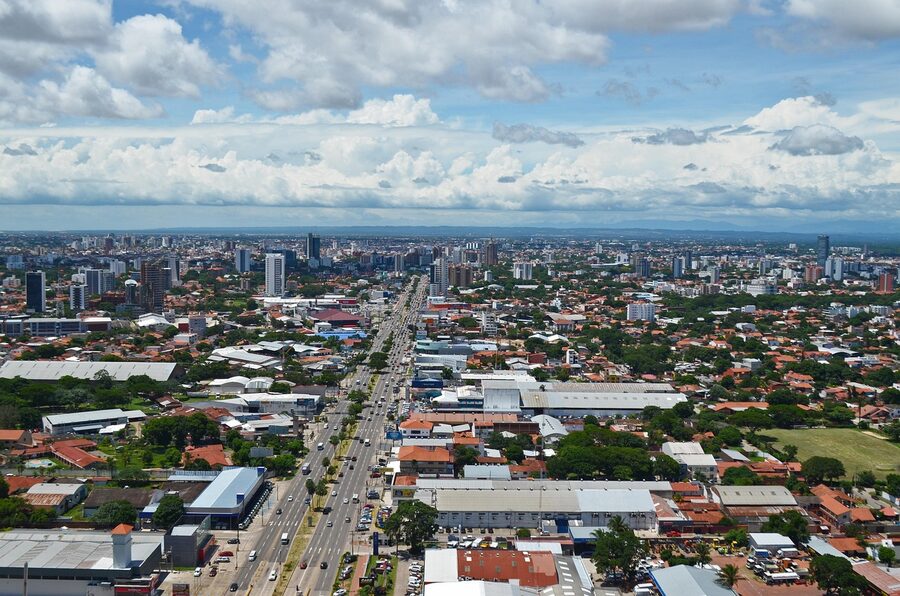
The flight from La Paz to Santa Cruz takes 50 minutes and crosses 3,200 vertical metres in the process. You leave the canyon city at 3,650m, drift over the eastern slopes of the Andes, and land at Viru Viru International Airport at 415m. Step out of the air-conditioned terminal and the heat hits you. The light is different. The street smell is different. The Spanish you hear has a more southern-cone cadence and a slower rhythm. You are still in Bolivia, but you would not know it from the landscape alone.

This guide covers Santa Cruz de la Sierra as a destination in itself: how the lowland tropical climate reshapes Bolivian cooking, urban life, and the daily rhythm; the city centre and the surrounding neighborhoods; the markets where the Amazonian and the Andean food cultures meet; the natural and cultural day trips that anchor the eastern travel circuit; and the practicalities of moving between Santa Cruz and the rest of the country.
In This Article
- The shift from the highlands
- How Santa Cruz is laid out
- Plaza 24 de Septiembre and the centre
- Markets and food
- The lowland context: Pantanal, Chiquitano, and the Amazon
- The Jesuit Missions of Chiquitos
- Day trips: Samaipata, Amboró, Lomas de Arena
- Where to stay by neighborhood
- Practical: getting in, around, and out
- What to skip
The shift from the highlands
If you have come from La Paz, the first thing your body notices is your own breathing. Suddenly, normal. The walks are easier. The morning headache is gone. The appetite that disappeared in the altiplano comes back at the first lunch. We cover the medical version of this transition in our altitude sickness piece; the experiential version is that Santa Cruz is the city travelers describe as their first deep breath after Bolivia.
The climate is genuinely tropical. Daytime temperatures sit around 28 to 33°C for most of the year; humidity is high; the wet season (November through March) brings serious thunderstorms; the dry season (May through October) is hot but cooler at night. The southern wind, called the surazo, sometimes drops temperatures by 15°C in a single day during May to August; if you arrive expecting consistent heat and find yourself in a 12°C surazo morning, that is the expected pattern, not a surprise.
The cultural shift is as real as the climatic one. Cruceño identity is distinct from highland Bolivian identity. The accent is different (closer to Argentine Spanish than to the Quechua-influenced Spanish of La Paz). The dominant Indigenous heritage in the lowlands is Guaraní, Chiquitano, Mojeño, and Ayoreo, not the Aymara and Quechua of the altiplano. The architecture is more modern, the streets are wider, the cars are newer, the bars stay open later. The city has more in common, in some respects, with Asunción in Paraguay or with Resistencia in northern Argentina than with the Bolivia most travelers came to see. That is part of what makes the visit interesting.
How Santa Cruz is laid out
The city is built around a series of concentric ring roads. The first ring (Primer Anillo) encloses the historic centre and Plaza 24 de Septiembre. The second through ninth rings extend outward in increasing diameter; most travelers spend their visit between rings 1 and 4. The locals navigate by ring numbers and the radial avenues that cross them. “Está en el segundo anillo, sobre Equipetrol” is a normal direction-giving sentence and is more useful than a street name.
Neighborhoods that matter for travelers:
- Centro / Casco Viejo: inside the first ring. Plaza 24 de Septiembre, the cathedral, the colonial-era frontage that survives in patches between modernist concrete. Where most short-stay visitors will base themselves.
- Equipetrol: the upscale district between the second and third rings. Modern hotels, the city’s main bar street, restaurants, several international chains. The “Equipetrol Norte” subdistrict has the highest concentration of nightlife in the city.
- Las Palmas / Urbarí: residential, leafy, the best concentration of cafés and small restaurants for a longer-stay visitor.
- Las Palmas / Plan 3000: the working-class outer rings. Plan 3000 specifically has the largest concentration of Indigenous and rural-to-urban migrants in the city; the area is genuinely interesting culturally but is not the safest at night for travelers.
- Zona Norte: where the modern shopping centres, the international school district, and most of the expat housing sits. Good for a longer stay but feels more like Brasília than like Bolivia.

The city is more spread out than La Paz or Sucre; you will spend more on taxis and use more of your time crossing between rings. Walking distances are deceptive (the central plaza is small but everything else is further than it looks). Plan accordingly.
Plaza 24 de Septiembre and the centre

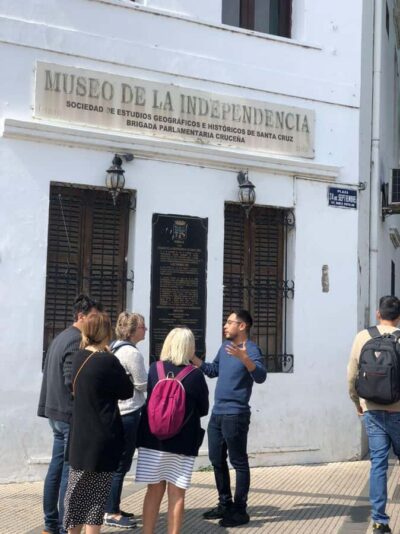
Plaza 24 de Septiembre is the historic and visual heart of the city. The plaza is named for the date in 1810 when Santa Cruz declared independence from Spain (in advance of the formal Bolivian independence date of 1825 in Sucre). The plaza is small, palm-lined, and surrounded by the most consequential buildings in the original colonial city: the Catedral Basílica de San Lorenzo, the Casa de la Cultura, the Palacio Departamental, several colonial-era arcades that were partly demolished and partly preserved through the 20th-century modernisation.

The Catedral itself, originally built in 1610 and reconstructed in 1845 after a major fire, is open mornings 7 to 11am and afternoons 5 to 7:30pm; the interior includes a small museum (around 25 BOB entry) with religious art from the broader colonial-era Chiquitos region. The cathedral tower can be climbed for a reasonable plaza view (around 20 BOB). The Casa de la Cultura, on the south side of the plaza, hosts free temporary exhibitions and is worth a 30-minute drop-in if anything is on.
The plaza on a Sunday afternoon is the city’s social space. Families come out for ice cream, vendors sell sonso (yuca-and-cheese skewers cooked over charcoal, around 6 to 10 BOB), and teenagers cluster on the benches around the central monument. The unofficial Saturday night ritual is to walk a slow lap of the plaza and stop at one of the corner cafés for a chocolate-and-pastry break. The cafés Lorca and Los Inmortales are the long-standing favorites for this; both serve until late.
Markets and food
The lowland food culture is its own thing, distinct from the highland cooking covered in our traditional cuisine piece. Yuca replaces the potato as the everyday starch. Surubí (the large Amazonian catfish) is the headline fish. Majadito, the toasted-rice-with-charque dish, is the regional comfort food. Cuñapé, the yuca-flour-and-cheese baked roll, is the bread you buy from morning bakeries.
The markets to visit:
- Mercado Los Pozos: in the centre, three blocks south of the plaza. The food and produce market that locals shop at; the upper floor has comedores serving majadito, sonso, and surubí for around 30 to 45 BOB. Daily, busiest Tuesday and Saturday morning.
- Mercado La Ramada: larger and slightly more chaotic, on the western edge of the centre. Better for textiles, traditional crafts, and street food. Pickpocketing risk is real here; keep your bag in front.
- Mercado Mutualista: the second-ring food market that is mostly local clientele; the chicharrón and surubí specialists work here on Saturday and Sunday.
For sit-down restaurants, the lowland-versus-highland-versus-international split runs three ways. Lowland regional: Los Hierros for traditional cruceño cooking (around 80 to 150 BOB per main), El Aljibe for surubí specifically. Modern Bolivian: Jardín de Asia (Bolivian-Asian fusion, around 100 to 200 BOB per main), Casa de Campo for the cruceño grill format. International: the Equipetrol main strip is heavily Italian and Argentine; for genuine Argentine grill, go to La Casona on Avenida Monseñor Rivero.
The drinks scene (covered in detail in our Bolivian drinks piece) leans tropical and informal in Santa Cruz. Cold drinks (mocochinchi, somó, fresh limonada) are the daytime defaults; cervezas Paceña and Taquiña dominate; the local craft beer scene is smaller than in La Paz but Saya has a Santa Cruz outpost.
The lowland context: Pantanal, Chiquitano, and the Amazon
Santa Cruz is the gateway to three of Bolivia’s major lowland ecosystems. The Pantanal, the world’s largest tropical wetland, sits across the eastern department; the Chiquitano dry forest, one of the largest tropical dry forests on Earth, occupies the central-east; the Amazonian basin extends north and west. Each is accessible from Santa Cruz on a 1-day to multi-day basis.
The environmental context is uncomfortable and worth knowing about. The 2024 fire season, covered in detail in our environmental problems piece, burned roughly 12 million hectares of these lowland ecosystems. The damage is genuine; many of the protected areas you might want to visit have suffered serious fire impact in the last seven years. The dry season air quality in Santa Cruz can hit hazardous levels for weeks during the August-November fire window. None of this means you should not visit; it does mean you should plan around fire weather, choose responsible operators, and read the situation as it stands rather than as it was a decade ago.
The Jesuit Missions of Chiquitos

The Jesuit Missions of Chiquitos, a UNESCO World Heritage Site, is one of the major cultural attractions of eastern Bolivia and very few highland-focused travelers know about it. The six surviving mission churches (San Javier, Concepción, Santa Ana, San Miguel, San Rafael, San José) sit in a loop east of Santa Cruz and were built between 1696 and 1760 by the Jesuit order working with Chiquitano Indigenous communities.
The architectural-historical significance is real. The mission churches are unique examples of Mestizo-Baroque architecture, with hand-carved wooden altars, painted ceilings, and pulpit ornamentation that combine European Baroque with Chiquitano indigenous artistic traditions. The ongoing Indigenous musical tradition (the Chiquitos Baroque music ensembles, performing in churches built specifically for the music) is a living cultural practice; the biennial Festival Internacional de Música Renacentista y Barroca Americana, held in late April or early May of even-numbered years, draws performers from across South America.
How to visit: the standard option is a 4-day organised tour from Santa Cruz, covering 4 to 6 of the missions, with overnights in San Javier and Concepción. Around 1,400 to 2,200 BOB per person depending on operator. Independent travel by public bus is possible but slow; the road network is rough and the bus connections add up to a 3-day commitment for what would be a 4-day organised trip. Operators worth knowing about: Misiones Tours (the longest-running specialist), Forrest Tours, Magri Turismo. The festival weeks are booked out months in advance.
Day trips: Samaipata, Amboró, Lomas de Arena

Samaipata is the headline day trip / overnight, 120 km west of Santa Cruz. The colonial town sits at 1,650m (a return to mild altitude after the lowland heat) and is the gateway to the El Fuerte de Samaipata UNESCO archaeological site, a pre-Inca ceremonial complex carved into a single sandstone outcrop. The site is the largest carved monolith in the Americas and the iconography includes serpents, jaguars, and astronomical alignments that suggest sophisticated pre-Inca cosmological practice. Around 50 BOB entry. Allow 2 to 3 hours on site. The town itself has a small but interesting expatriate-community café scene and is worth an overnight; we will cover Samaipata in detail in a separate piece.

Parque Nacional Amboró is the protected area between the Andes and the Amazon, accessible from both Santa Cruz and Samaipata. The park covers around 4,400 km² and contains an extraordinary range of species (some of the highest bird diversity of any protected area in South America, jaguars, spectacled bears at the western edge, giant otters in the river systems). The park has two main access regions: the south access via Samaipata (drier, more cloud-forest), and the north access via Buena Vista (wetter, more lowland-tropical). 2 to 3-day organised tours from Santa Cruz are around 1,200 to 1,800 BOB. Independent travel requires careful planning and a registered local guide.

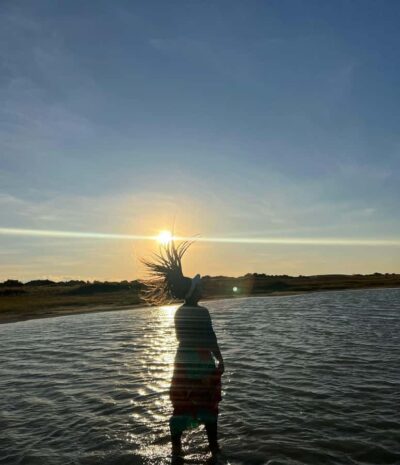
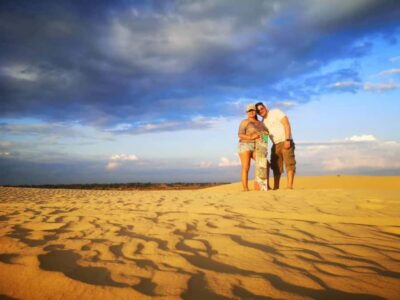
Lomas de Arena Regional Park is the easy day trip: a sand-dune system 12 km south of Santa Cruz, with shallow lakes between the dunes that fill seasonally. Half-day organised trips from Santa Cruz are around 200 to 300 BOB; the city’s heat plus the dune walking makes this best on a winter morning. Skip on a 35°C summer afternoon.
Other options worth knowing: the Refugio Los Volcanes (a private reserve in the Amboró region), the Curichi El Cuajo wetland reserve (north of the city, good for birding), and the Sucre-Samaipata-Santa Cruz route by car if you want to see the geographic transition gradually rather than by flight.
Where to stay by neighborhood
Centro / Casco Viejo is the obvious choice for a 2 to 4-day visit: walking distance to the plaza, the markets, and the bus terminal. Hostal Pateando Latas (around 80 to 120 BOB per dorm bed) is the long-running budget option. Hostal Río Magdalena (mid-range, 250 to 400 BOB doubles) and Cosmopolitano Hotel Boutique (upper-mid, around 500 to 700 BOB) are the two reliable picks for travelers who want comfort within walking distance of the centre.
Equipetrol is right for travelers who want the bar scene and the Italian / Argentine restaurants on their doorstep: Hotel Camino Real Santa Cruz and Hotel Los Tajibos are the two upper-tier options at 800 to 1,500 BOB per night.
Las Palmas / Urbarí is for longer stays. The neighborhood has a different rhythm; cafés, small restaurants, the kind of streets where you can walk to dinner. Airbnb works well here for a one-week-plus stay.
Practical: getting in, around, and out
Viru Viru International Airport (VVI) is 16 km from the centre. The airport bus (line 135) departs every 10 to 15 minutes, takes 40 to 50 minutes to reach the central terminal, and costs 6 BOB. Uber and registered radio taxis run the same route for 80 to 130 BOB. The airport has a reliable money-changer counter and ATMs that accept Visa and Mastercard. Pick up a Bolivian SIM (Tigo or Entel) at the airport if you have not already done so.
From La Paz: BoA and EcoJet fly multiple times daily, 45-minute flight, around 500 to 800 BOB return. Overnight bus is available but the route is long (around 16 hours) and the road descends 3,200m through serpentine mountain passes; flights are the standard.
From Cochabamba: 9 to 10-hour day or overnight bus, 100 to 170 BOB; or 45-minute flight, 400 to 700 BOB return.
From Sucre: overnight bus, 12 hours, 90 to 150 BOB; or via Cochabamba flight connection.
From Argentina: direct flights from Buenos Aires, Iquique, and Asunción operate several times weekly. The land border via Yacuiba is open year-round and is a 16 to 20-hour bus ride to Buenos Aires via Salta.
Within Santa Cruz: Uber works reliably and is the comfortable choice; expect 25 to 80 BOB for crosstown trips depending on distance. Street taxis are fine but negotiate the fare at the start. The micro buses (small public buses) run radial and circumferential routes and cost 2 to 3 BOB; useful if you can read the route signs but slow during peak hours.
Money: ATMs are universal in the centre and Equipetrol; Bolivian boliviano is the daily currency though US dollars are accepted at upper-end hotels and tour operators. Card acceptance is more reliable in Santa Cruz than in highland cities; most mid-range and above restaurants take Visa and Mastercard.
Safety: Santa Cruz has a higher rate of opportunistic theft than the highland cities. Standard precautions apply: keep your bag in front in markets, do not flash phones in transit hubs, take an Uber rather than a street taxi after dark, and avoid Plan 3000 and the outer rings at night unless you have a specific reason to be there.
What to skip
The “jungle tour” packages sold in the centre. Most are short, badly run, and based on captive-animal “wildlife encounters” that are ethically dubious. If you want serious wildlife, go to Amboró with a registered specialist operator or commit to a multi-day Pantanal trip; the day-tour version is not worth the time.
The “free city tour” walks that depend on tipping for income. The guides are often inexperienced, the tours are surface-level, and the time investment is rarely repaid. Pay for a paid 3-hour Santa Cruz Walking Tour from a registered operator (around 100 to 180 BOB) if you want a real introduction.
Day-tripping the Jesuit Missions. The 4-day loop is what makes the Missions visit worthwhile; cutting it to one day means you see one church and skip the genuine cultural texture. Either commit to the full loop or skip the Missions and prioritise something else.
The shopping malls in Zona Norte. Bolivian malls are functional but not interesting; if you have a limited number of days, the malls are a poor use of them.

Santa Cruz is the city in Bolivia that surprises travelers most. After the highland landscapes and the canyon-city density of La Paz, the wide tropical streets and modernist architecture of Santa Cruz can feel like a different country; the Indigenous heritage and the food and the language you encounter walking through the centre quickly remind you it is still Bolivia, just a Bolivia that highland travelers rarely think to visit. Three days is the minimum for the city itself. A week, including Samaipata and a section of the Mission Loop, is when the eastern half of the country starts to make sense.
You Might Also Enjoy
 La Paz Travel Guide: The World’s Highest Capital, Cable Cars, and What to Actually Do
 Tarija Travel Guide: The Wine Country, Singani Distilleries, and the Mediterranean Side of Bolivia
 Sucre Travel Guide: Bolivia’s White City, Independence Capital, and Where to Slow Down
 Uyuni and the Salar: A Friend’s Guide to the Three Day Salt Flats Tour
Book a day from Santa Cruz
The mission circuit, the Amboró foothills and the city itself with someone who can explain the anillos.



.jpg)


