

Reviewed · UYUNI SALT FLATS TOURS
From La Paz: Uyuni Salt Flat Tour & Overnight Roundtrip Bus
The salt flat turns the sky into a mirror. This three-day La Paz-to-Uyuni plan pairs comfortable overnight buses with a full day across Bolivia’s great white expanse. I like the small group, limited to 11 people, and the guides’ knack for setting up funny perspective photos. My main caution is the long wait in Uyuni before the 10:30 a.m. tour and the tiring return night bus.
At $275 per person, you pay for transport, two overnight journeys, meals on the bus, a 4WD outing, an English-speaking guide, and lunch. Guides such as Luis, James, Estefanía, Marcia, and José have been praised for their warmth and photo skills, though the handoff to the return bus can feel less clear than the main tour.
In This Review
- Key points to know before booking
- Why this La Paz-to-Uyuni plan works
- What to expect on the Todo Turismo night bus
- Morning in Uyuni leaves three hours to fill
- The Train Graveyard gives you an odd first stop
- Colchani shows the working side of salt
- The Salar de Uyuni delivers the day’s great spectacle
- Incahuasi brings giant cacti to a white world
- Perspective photos are part of the fun
- Sunset comes with wine and sudden cold
- The return connection needs your attention
- Is $275 a fair price?
- Who will enjoy this trip most?
- Should you book this La Paz salt-flat tour?
- FAQ
- Where is the meeting point?
- What time does the bus leave La Paz?
- What is included in the price?
- Is the Incahuasi Island fee included?
- What should I bring?
- Can I cancel or pay later?
Key points to know before booking

- Two overnight bus rides: Todo Turismo provides reclining seats, dinner, breakfast, WiFi, heating, toilets, water, and polar blankets.
- A full day in the Salar de Uyuni: The route includes the Train Graveyard, Colchani, salt features, Ojos de Agua Salada, the salt museum, and sunset.
- Small groups help with photos: A group of no more than 11 makes it easier for the guide to arrange perspective shots.
- Incahuasi depends on the season: The island and its giant cacti cannot be visited from January through March because of rainy-season conditions.
- Bring cash and warm clothes: Incahuasi costs 30 BOB, and the flats become cold soon after sunset.
- The return transfer needs attention: You must get from the tour office to the bus office yourself by 8:30 p.m.
Why this La Paz-to-Uyuni plan works
The Salar de Uyuni sits in Bolivia’s Potosi Department, far from La Paz. Reaching it by road is a serious commitment, but this tour solves the main problem: you do not need to arrange separate buses, a hotel in Uyuni, a local jeep, a driver, and a guide on your own.
The schedule uses two overnight bus rides to save daytime. You leave La Paz at 9 p.m., arrive in Uyuni at about 7:30 a.m., spend the day on the salt flats, then board the return bus at 9 p.m. You reach La Paz between 6:15 and 6:35 a.m. the next morning.
That makes the trip useful if your Bolivia schedule is tight. You get the country’s most famous natural sight without spending several extra nights away from La Paz. The trade-off is clear: you spend two nights sleeping on a bus, not in a bed.
The tour earns a 4.5 out of 5 rating from 327 bookings, and the praise focuses on the parts that matter most: the remarkable scenery, the friendly guides, the comfortable bus, the lunch, and the carefully arranged photographs. The weaker points are also consistent: the early-morning wait in Uyuni and some confusion around the return bus.
You can also read our reviews of more tours and experiences in La Paz.


What to expect on the Todo Turismo night bus
You check in at the Todo Turismo office at 8:30 p.m. and depart La Paz at 9 p.m. Get there on time. The office is in a busy area, and finding it at night can take a little patience, so allow yourself enough time to locate the entrance and handle check-in without a last-minute dash.
Todo Turismo is a strong part of the package. The bus provides reclining seats, heating, toilets, WiFi, a first-aid kit, a bottle of water, a hot drink, and a polar blanket. Dinner and breakfast are served on board, with meat and vegetarian options listed for the meals.
The seats are comfortable enough for many people to sleep through much of the ride. Still, comfort is personal. One useful detail is that the footrest may remain down instead of lifting fully, which can make the position awkward for some people. Bus temperatures can also shift from hot to chilly.
I would pack earplugs, an eye mask, and layers. You should also bring a small snack. The bus dinner is convenient but portions can be modest, while breakfast has been described as a basic bread-and-cheese or ham meal with a sweet juice drink.
If you need vegetarian food, make that request when you book and repeat it by email or WhatsApp before departure. One passenger received a regular meal because the bus company had not received the dietary information. That is not a reason to reject the tour, but it is a reason to confirm the request.
Morning in Uyuni leaves three hours to fill
The bus arrives in Uyuni at around 7:30 a.m. You have free time before the salt-flat outing begins at 10:30 a.m. Use it well: buy water, snacks, and any other supplies you need before heading to the activity provider’s office, one block from the bus station.
This wait is the least polished part of the day. You have roughly three hours in a small town before the jeep departs, and there is not much planned during that stretch. Some people use the time for breakfast and coffee; others simply sit with their luggage and wait.
The practical lesson is simple: do not expect a morning sightseeing program in Uyuni. Bring something to read, get food early, and keep your passport, money, and important items close. The office offers a place to gather, but the tour does not begin until 10:30.
This is also a good time to check that your phone is charged. You will want it later for photographs, and WiFi on the bus should not be treated as a substitute for a fully charged device.
The Train Graveyard gives you an odd first stop
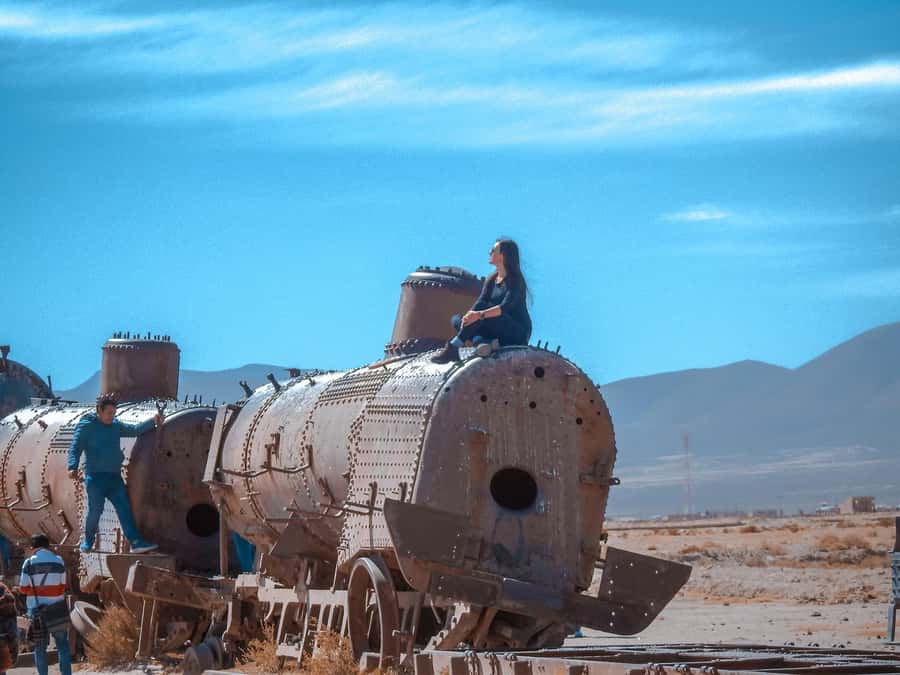
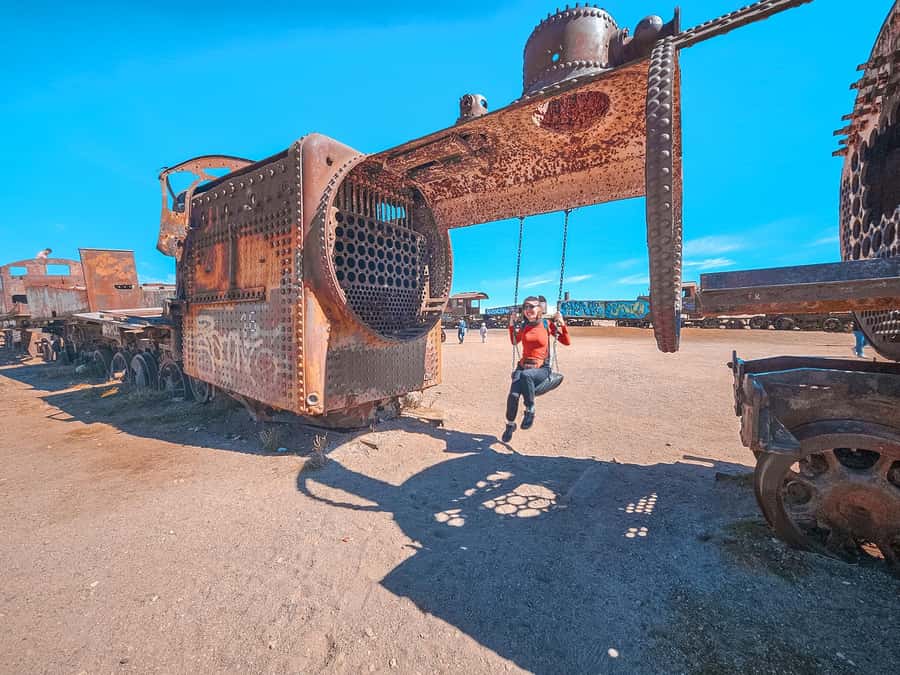
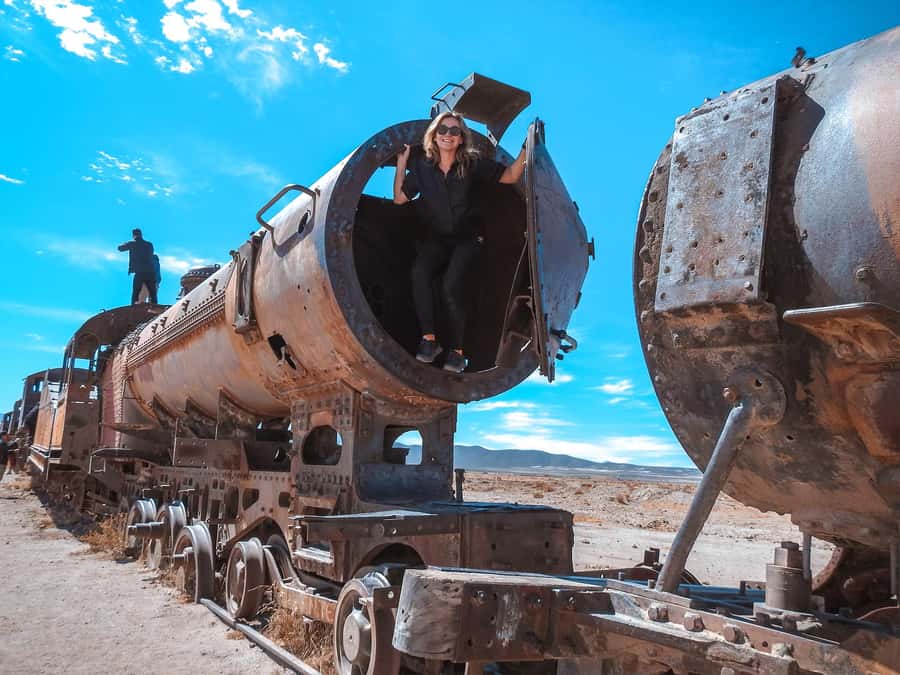
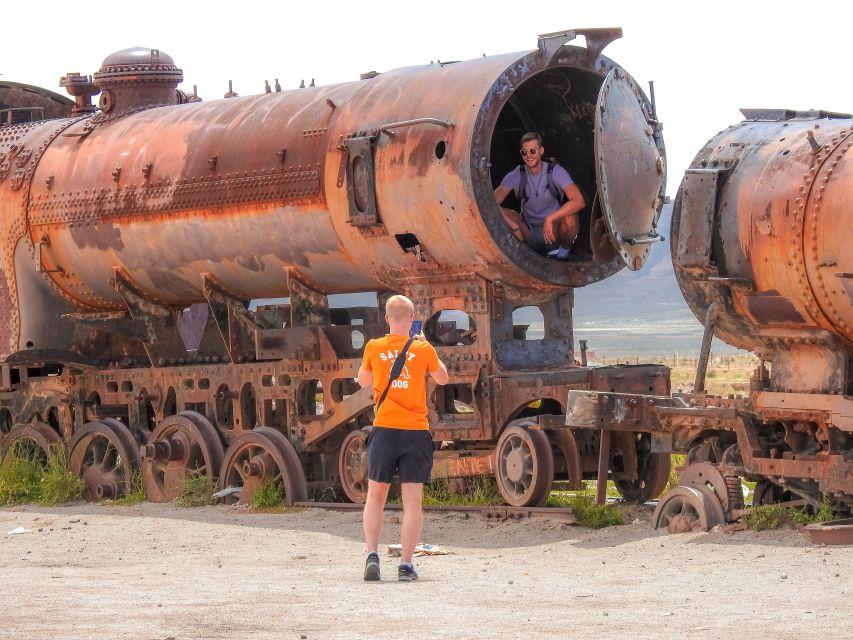
The first stop is the Train Graveyard on the edge of Uyuni. Rusting locomotives sit in the open air, a strange collection of old railway equipment against the empty surroundings.
It is photogenic in a rough, weathered way, but it is not the main reason to book this outing. If you love abandoned machinery, you may enjoy climbing around the old trains and studying their shapes. If you are eager to reach the salt, this stop can feel like a delay.
The timing is useful, though. It breaks up the drive and gives your guide a chance to introduce the region before the day reaches its main attraction.
Colchani shows the working side of salt

Next comes Colchani, a small settlement beside the flats. Salt miners’ workshops sell handicrafts made from salt, along with textile work made from llama and alpaca wool.
This stop gives you a little context for the salt economy and a chance to buy a local souvenir. Salt sculptures and other salt products are part of the visit. The shopping element can feel sales-oriented, so you should treat it as an optional browsing stop rather than the heart of the day.
I like it best as a short look at life around the Salar. You see that this is not only a giant white photo set. People work around the salt, shape it into objects, and sell regional textiles. Still, you may prefer to spend more time on the flats themselves if the schedule feels tight.

The Salar de Uyuni delivers the day’s great spectacle
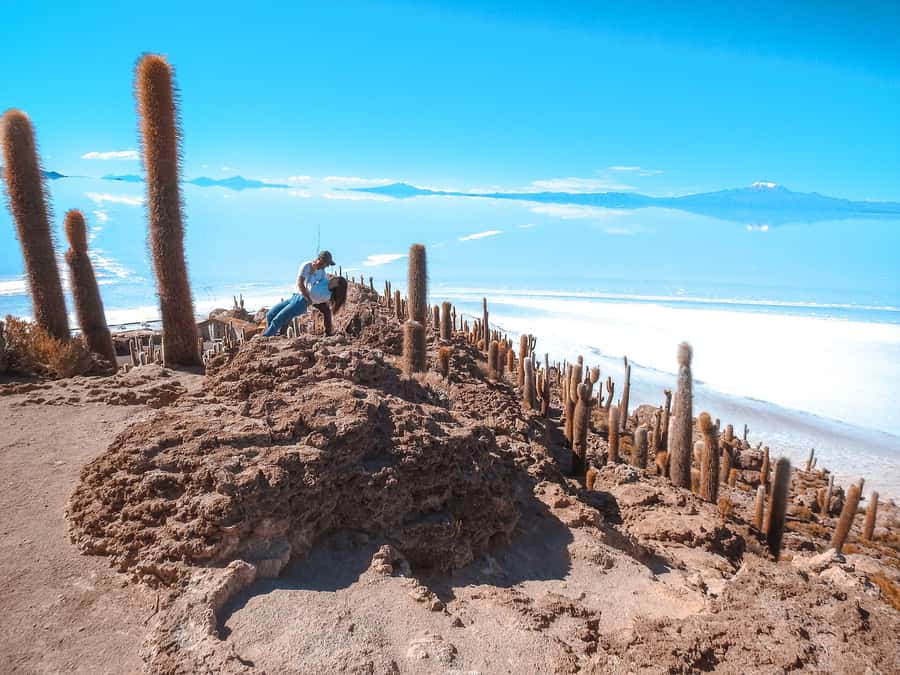
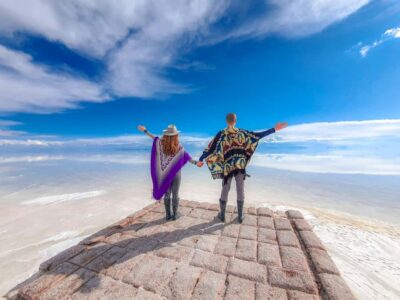
Once the 4WD vehicle reaches the salt flat, the scale changes everything. The ground spreads out in a nearly unbroken white plane, and the horizon can seem to disappear.
You visit Ojos de Agua Salada, the salty-water openings in the flat, and a building made entirely from salt that now serves as a museum. The route also includes the Flags of the World restaurant. You can bring your own national flag and place it there free of charge.
The salt museum is an unusual stop, but the broad salt surface is what most people remember. You will have time to walk, look across the white expanse, and take photographs in places where the distance makes ordinary objects look unreal.
The guide and driver matter here. The best part of a small-group trip is not simply having fewer people in the jeep; it is having someone willing to help arrange the scene, suggest poses, and keep the group moving without rushing every stop. Guides including Belmar, Juan, Javier, Bismarck, and Eddie R. have been praised for their friendly explanations and practical help.
Incahuasi brings giant cacti to a white world
Lunch is served while you travel toward Incahuasi Island. The meal has included quinoa, cooked vegetables, beef, avocado, local cheese, and tomatoes, though food can vary. It is a welcome break after the morning’s drives and stops.
Incahuasi is one of the day’s most memorable contrasts. Giant cacti rise from a rocky island surrounded by salt, while petrified coral forms the island’s unusual rock shapes. You can hike to the top for a wider view across the Salar.
There is an extra entry fee of 30 BOB, or about $5, and it is not included in the tour price. Carry cash for this payment.
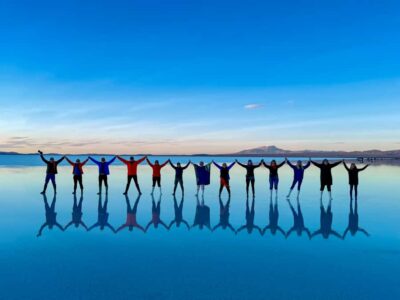
The season matters a great deal. From January through March, rainy conditions make Incahuasi inaccessible. That does not mean the trip is pointless during those months. The water on the flats can create the famous mirror effect, making the sky and ground blend together. You simply exchange the cactus-island visit for a different kind of scenery.
This is one of the tour’s most important choices. In the dry season, you get the island, cacti, and hard white geometric surface. In the rainy season, access to Incahuasi is removed, but the reflective water may create the strongest photographs.
Perspective photos are part of the fun
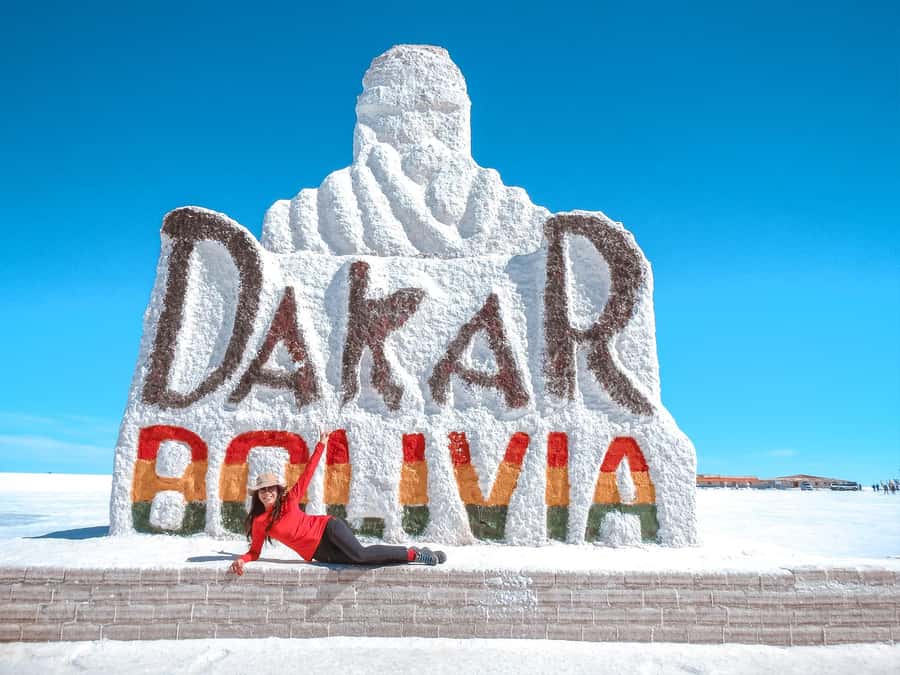
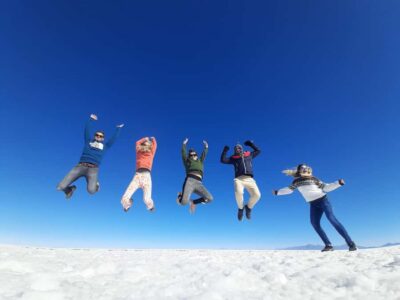
The Salar is ideal for forced-perspective photography. With no clear sense of distance, a person can appear to hold another person in their hand, stand inside a bottle, or perform other playful tricks.
Your guide will help organize these shots. Guides such as Estefanía, James, and José have been singled out for their ability to take creative photos and videos. You should expect to spend real time arranging poses rather than simply taking a quick group photo and moving on.
Bring a few simple ideas, but do not overplan. The best pictures often come from using whatever you have: a water bottle, a hat, a backpack, or a small souvenir. A patient guide and a cooperative group make this part much more enjoyable.
The small-group limit of 11 is valuable here. With fewer people competing for the same spot, you have a better chance of getting clear photographs and enough room to try several poses.
Sunset comes with wine and sudden cold
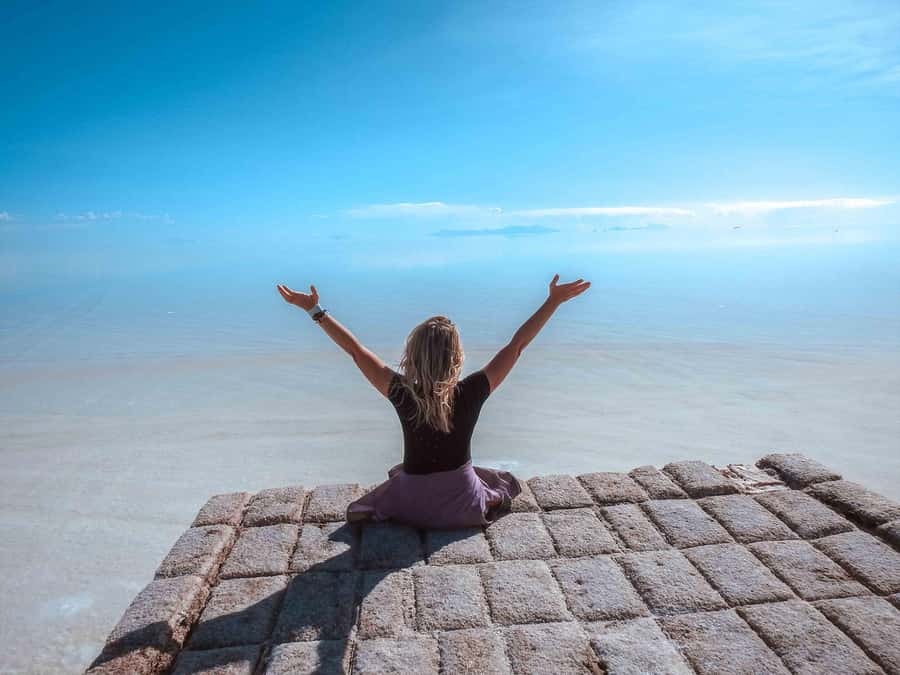
Late in the day, the 4WD heads to a broad area for sunset. The sun spreads color across the salt, and the flat surface gives the scene an unusually open feel.
A glass of wine is served as part of the sunset moment. It is a simple touch, but it gives the end of the day a sense of occasion after hours of driving, walking, and taking photographs.
Pack a warm layer in your day bag. The temperature can drop sharply as soon as the sun disappears, and the white surface offers little shelter from the cold. Do not rely on the bus blanket for the sunset stop; keep your own jacket or fleece easy to reach.
The schedule may move on soon after the sun goes down. If your dream is to stay for a long twilight or more night photography, this tour may feel too tightly timed. Its goal is to show you the major sights and return you to Uyuni in time for the bus.
The return connection needs your attention
The 4WD returns to the provider’s office in Uyuni between 7:15 and 7:45 p.m. You then make your own way to the bus office and must be there by 8:30 p.m. for the 9 p.m. departure.
This handoff deserves more care than the outward journey. Keep the bus company details available on your phone, listen closely to the guide’s instructions, and do not wander far from the office after the jeep returns.
There have been occasions when a bus company change, including a change connected with Carnival, made the return confusing. Such changes are not part of the normal advertised schedule, but they show why a valid WhatsApp number and current contact details matter.
The return bus includes the same general service: dinner, breakfast, water, a hot drink, heating, WiFi, toilets, and a blanket. You arrive in La Paz between 6:15 and 6:35 a.m., likely tired but ready to continue your trip or rest.
Is $275 a fair price?
At $275 per person, this is not the cheapest way to see Uyuni. You are paying for the round-trip bus, two dinners, two breakfasts, local 4WD transport, a driver, an English-speaking guide, and lunch.
The value comes from convenience and time. You do not need to arrange the long-distance buses separately or find a local operator after arriving in Uyuni. You also get a small group rather than a large convoy, and the guide’s help with photos adds something you would not get from a basic transfer.
The price makes the most sense if you are based in La Paz and have only a few days available. If you are already staying in Uyuni, paying for two bus rides from La Paz may not suit your plans. You also need to add drinks, snacks, and the Incahuasi entry fee when applicable.
Free cancellation up to 24 hours before departure and the reserve-now, pay-later option make the booking less rigid. Still, check the starting time and confirm your contact details before you go.
Who will enjoy this trip most?
I would choose this tour if you want to see the Salar de Uyuni but cannot spare several days for a slower visit. It suits people who accept overnight buses in exchange for saving daytime and who want a guide to handle the route and photographs.
It is also a good match for first-time visitors to Uyuni. You see the classic stops in one day, get transport between them, and have an English-speaking guide available alongside the Spanish-speaking team.
I would think twice if you need a full night’s sleep, dislike tightly timed itineraries, or want a long, quiet stay on the salt itself. The bus is comfortable by road-trip standards, but it is still a bus. The morning wait and the short sunset turnaround can test your patience.
Bring your passport or ID card, warm layers, earplugs, an eye mask, water, snacks, and cash for Incahuasi. Pets are not allowed.
Should you book this La Paz salt-flat tour?
Yes, if your priority is seeing the Salar de Uyuni within a short Bolivia itinerary. The overnight bus is a fair trade for a full day of salt, cacti, unusual stops, creative photographs, lunch, and sunset.
Just set realistic expectations. You will not have much free time in Uyuni, the Train Graveyard and Colchani may feel secondary, Incahuasi disappears from the route in the rainy season, and the return bus connection deserves careful attention. If those limits work for you, the astonishing salt flat more than earns the long ride.
FAQ
Where is the meeting point?
Check in at the Todo Turismo bus office in La Paz at 8:30 p.m.
What time does the bus leave La Paz?
The La Paz to Uyuni bus departs at 9 p.m. The return bus from Uyuni also departs at 9 p.m.
What is included in the price?
The price includes round-trip La Paz–Uyuni bus tickets, two dinners, two breakfasts, bus services, 4WD transportation during the Uyuni tour, a local driver, an English-speaking guide, and one lunch.
Is the Incahuasi Island fee included?
No. Entry costs 30 BOB, or about $5, and must be paid separately. Incahuasi cannot be visited from January through March because of rainy-season conditions.
What should I bring?
Bring your passport or ID card. Water, snacks, warm clothing, earplugs, and an eye mask are also practical for the bus and the cold sunset stop.
Can I cancel or pay later?
You can cancel up to 24 hours in advance for a full refund. The reserve-now, pay-later option lets you hold a place without paying immediately.
More Tours in La Paz
More Tour Reviews in La Paz
Not for you? Here's more nearby things to do in La Paz we have reviewed


Uyuni Salt Flats Tours, compared
 ★ 4.5Uyuni tour express from La Paz by busFrom $269172 reviews
 ★ 4.4From Uyuni: Red Lagoon & Uyuni Salt Flats 3-Day Guided TourFrom $354160 reviews
 ★ 4.3La Paz: 5-Day Uyuni Salt Flats by BusFrom $486153 reviews
 ★ 4.1La Paz: Uyuni Salt Flats & San Pedro de Atacama 3-Day TourFrom $469145 reviews
Browse the lists this tour appears in