
Reviewed · UYUNI SALT FLATS TOURS
From La Paz: Uyuni Salt Flats 2-Day Tour with Bus Transfers
White salt turns the world upside down. I like the efficient overnight bus connection from La Paz, which saves you from arranging separate transport, and I like how much fits into the Uyuni day: the Train Cemetery, Colchani, Incahuasi Island, lunch, photo stops, and sunset wine. The small group, capped at six people, should also make the day easier to manage.
The trade-off is the schedule. You travel overnight in both directions, spend one packed day on the salt flats, and return to La Paz early the next morning. Incahuasi Island is also closed to access from January through March when rain makes the route unsuitable, so check the season before you book.
This is a strong choice if you want the classic Uyuni sights without organizing a separate hotel stay or local tour. Recent ratings average 4.3 out of 5 from 90 bookings, with special praise for the scenery and guide Carlos, described as personable, fun, and very accommodating when he leads the day.
In This Review
- Key points at a glance
- The overnight ride from La Paz to Uyuni
- A quiet morning before the salt-flat tour
- Rusting rail cars at the Train Cemetery
- Colchani, salt craft, and a working settlement
- The Salar de Uyuni’s endless white surface
- Incahuasi Island and its giant cacti
- Perspective photos on the salt
- Sunset, changing colors, and a glass of wine
- The return bus and what $195 buys you
- Who should book this Uyuni trip?
- Should you book the La Paz to Uyuni tour?
- FAQ
- How long does the tour take?
- What time does the bus leave La Paz?
- What is included in the $195 price?
- Can I visit Incahuasi Island during the rainy season?
- What languages are available?
- Can I cancel the booking?
Key points at a glance

- Two overnight bus journeys: Leave La Paz at 9 p.m. and reach Uyuni around 7:30 a.m.; return at 9 p.m. for a La Paz arrival around 6:15–6:35 a.m.
- A six-person maximum: The small group suits you if you prefer a more personal day and easier photo planning.
- The Train Cemetery comes first: Rusting rail cars on the edge of Uyuni provide a stark opening to the salt-flat route.
- Colchani shows local craft: Look for salt handicrafts, llama and alpaca textiles, and small workshops connected with salt mining.
- Incahuasi adds height and texture: Giant cacti and petrified-coral rock formations break up the endless white.
- Sunset includes wine: The final stop pairs changing colors across the Salar de Uyuni with a glass of wine.
The overnight ride from La Paz to Uyuni
Your first task is getting to the bus office in La Paz by 8:30 p.m. for registration. The coach leaves at 9 p.m., so give yourself enough time to find the correct office and settle in before departure. The meeting point can vary with the option you book, so check those details carefully.
The bus is set up for an overnight journey. Heating, toilets, a polar blanket, Wi-Fi, a first-aid kit, a hot drink, and a bottle of water are listed as part of the service. Breakfast is also included, with the activity details describing breakfast on the transfer and in Uyuni.
That equipment matters. Uyuni sits high, and the early hours can be cold. A blanket and heating make the ride more manageable, but I would still wear warm layers rather than rely only on the coach. Bring snacks as well, since snacks and extra water are not included.
This transfer is practical rather than scenic. You are using the night to cover the distance, which lets you reach the salt flats without spending an extra day on the road. The cost is some sleep and a fairly early start in Uyuni.
A few more La Paz tours and experiences worth a look

A quiet morning before the salt-flat tour
The bus reaches Uyuni at about 7:30 a.m. You have free time to buy snacks and water before meeting your guide at the local office. The listed start time for the local tour is 10:30 a.m., so the gap is not a mistake; local companies and sightseeing points begin operating later in the morning.
Use this pause wisely. Buy enough water for the full day, since the white salt reflects strong light and the air can feel dry. Eat your breakfast, organize your camera, and keep your warm clothing close. Temperatures can change sharply between the chilly morning and the bright salt flat later in the day.
The exact shape of this waiting period depends on the bus arrival and local arrangements. It is not sightseeing time, but it gives you a chance to get your bearings before the guided portion begins. If you dislike early-morning downtime, this is the main inconvenience built into the schedule.
Once you meet your guide, the day moves by vehicle toward the Salar de Uyuni. With a group of no more than six, you should have an easier time hearing explanations and arranging group photos than you might in a large coach party.
Rusting rail cars at the Train Cemetery
The first major stop is the Cementerio de Trenes, or Train Cemetery, on the outskirts of Uyuni. Rusting locomotives and rail cars sit exposed against the open ground, creating a strange contrast with the clean white expanse you will see later.
This stop works well as an introduction because it is visually different from the salt flat. The old machinery has a stark, almost eerie quality, and the open setting gives you room to photograph the shapes from several angles.
Expect a photo-focused visit rather than a long museum presentation. The appeal is in the setting, the weathered metal, and the feeling of seeing industrial remains far from a working railway. Wear shoes suitable for uneven ground and be careful around the old cars.
The Train Cemetery is close to Uyuni, so it also helps ease you into the day before the larger stops begin. You get a quick sense of the area, then move on toward Colchani and the salt.
Colchani, salt craft, and a working settlement
Colchani is a small settlement on the edge of the Salar de Uyuni. It is best understood as a brief local stop, not a full town tour. You can look through handicrafts made from salt along with textile pieces made from llama and alpaca wool.
The workshops give the visit a human scale. The salt flat can feel so vast that it becomes almost abstract; Colchani reminds you that people work with this material and sell objects connected to the area. If you want a small souvenir, this is the logical place to look.
Keep your expectations sensible. The stop is short, and the activity does not promise a detailed demonstration of salt mining. You will see workshops, crafts, and the settlement itself rather than spend hours studying local production.
This is also a good point to check your supplies. Snacks and additional water are your responsibility, and the next part of the day takes you into a far more exposed setting.
The Salar de Uyuni’s endless white surface
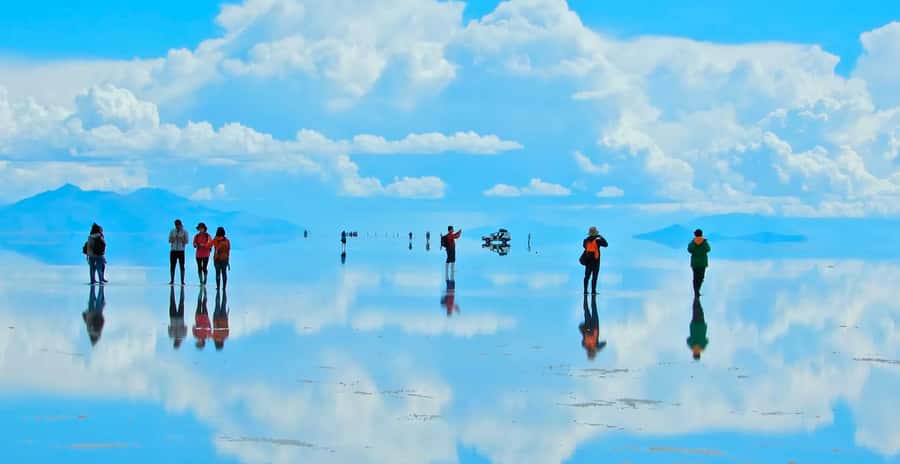
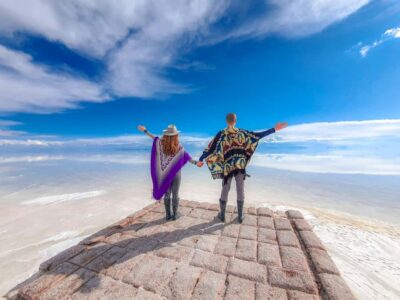
The main attraction is the Salar de Uyuni itself. Once you reach the salt flat, the horizon seems to stretch without a clear edge, and the white ground reflects so much light that sunglasses and sunscreen become practical gear rather than optional extras.
You will have time to take photographs across the broad salt surface. The tour also includes a stop at the Ojos de Agua Salada, where you can wade in the saltwater eyes. The experience changes from simply looking at the salt to noticing its water, texture, and unusual surface features.
A salt hotel, now used as a museum-restaurant, is another stop along the route. Seeing a building made entirely of salt gives you a memorable reminder that this is not just a scenic viewpoint. Salt is part of the area’s daily economy and local identity.
The white surface can be visually dazzling, but it can also be hard on your eyes. Bring sunscreen, water, a camera, comfortable clothing, and warm layers. The supplied advice to wear warm clothing is worth taking seriously, even if the sun feels intense.




Incahuasi Island and its giant cacti

After lunch, the route continues to Incahuasi Island. The island rises from the salt flat and gives you a chance to walk uphill, see giant cacti, and examine rock formations made of petrified coral.
This is one of the day’s most useful changes of pace. The salt flat offers scale and simplicity; Incahuasi supplies height, plants, and rough stone. From the top, you can look back across the white expanse and understand its size in a different way.
The visit requires a hike, so this is not a completely effortless sightseeing day. The activity is not suitable for people with back problems, and it is not designed for wheelchair users. Pregnant women are also advised not to take part.
The seasonal limitation is important. From January through March, rainy-season conditions may prevent access to Incahuasi Island. The rest of the salt-flat route may still operate, but you should not book this trip assuming the island visit is guaranteed during those months.
Perspective photos on the salt

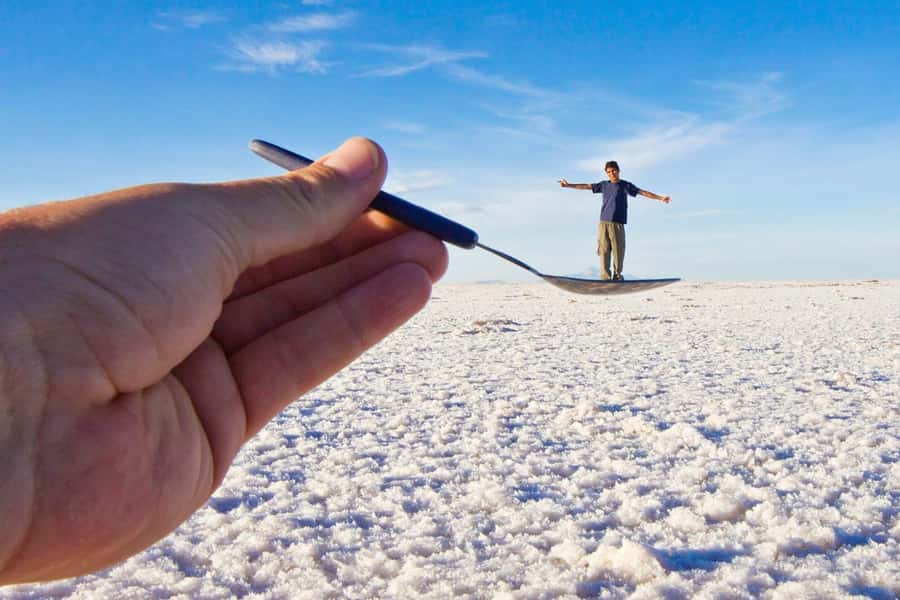
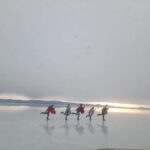
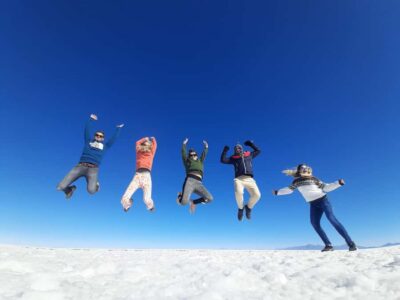
The Salar de Uyuni is famous for photographs that play with scale. The flat, bright surface makes it possible to arrange people in ways that distort perspective and proportion.
The guide and group will have time to organize these pictures. A small group helps here because fewer people need to move into position, and you can spend less time waiting for a large crowd to finish a shot.
Bring a camera, but do not forget your phone if that is your main tool. The important part is timing, cooperation, and a clear patch of salt. The photos are fun because they use the plainness of the setting as a visual trick.
The bright surface can make screens and camera displays difficult to see. Adjusting your camera before the photo stop and keeping sunscreen handy will save time. You may also want to protect your equipment from salt and dust, though no special camera gear is included.
Sunset, changing colors, and a glass of wine
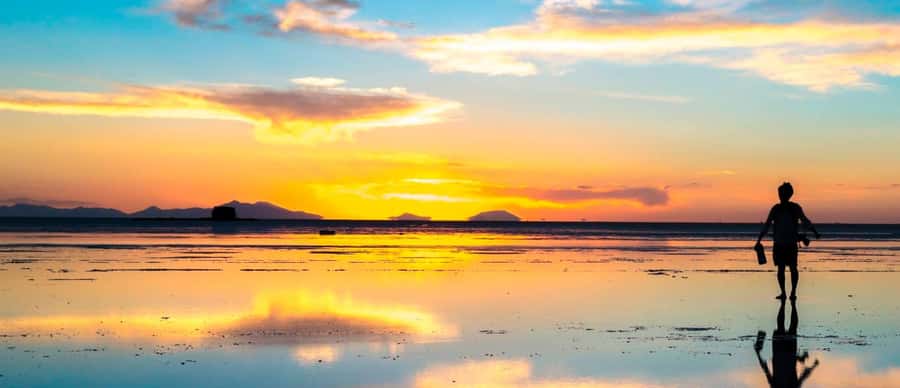
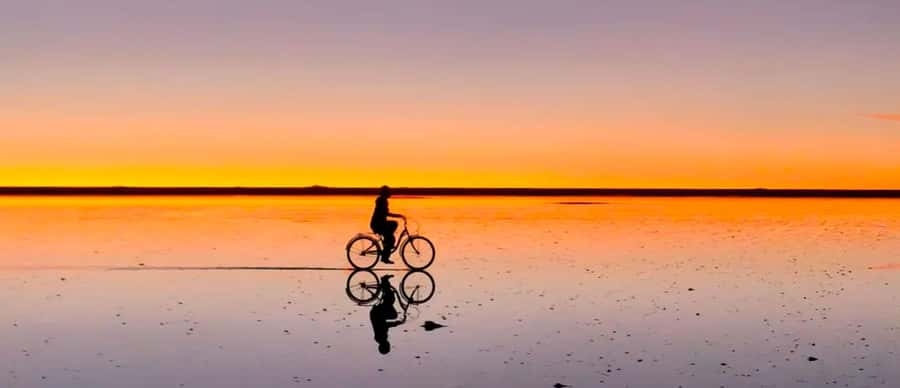
The day ends at a large open area of the salt flat for sunset. Colors spread across the white surface as the light fades, giving the final stop a calmer feel after the movement and photo planning earlier in the day.
A glass of wine is included in the sunset moment. It is a pleasant finishing touch, but remember that alcoholic drinks are not allowed in the vehicle. The wine is for the designated stop, not for the bus ride.
Sunset also explains the long schedule. The local tour begins at 10:30 a.m. and returns to Uyuni between 7:15 and 7:45 p.m., leaving just enough time to reach the 9 p.m. bus back to La Paz. You will not have much spare time, so keep track of your group and follow the guide’s return instructions.
The schedule is tight, but it allows you to see the salt flat in different light. The daytime glare, late-afternoon colors, and final sunset each show the Salar in a different mood.
The return bus and what $195 buys you

After returning to Uyuni, you go to the bus office on your own at 8:30 p.m. for the 9 p.m. departure. Arrival in La Paz is expected between 6:15 and 6:35 a.m. the next morning.
That means the advertised two-day trip really uses two nights of transport and one full day of sightseeing. Read it that way before booking. You are not getting two complete days on the salt flat; you are getting an efficient overnight connection wrapped around a focused Uyuni excursion.
At $195 per person, the value lies in convenience. The price covers round-trip bus transport, the guided Salar de Uyuni tour, breakfast, lunch, and several useful bus comforts: heating, toilets, a blanket, water, a hot drink, Wi-Fi, and a first-aid kit.
You still need to budget for snacks, extra water, and other personal expenses. The trip makes financial sense if you want transport and the local day arranged together. It is less appealing if you want a slow schedule, lots of unscheduled time, or a guaranteed Incahuasi visit during the rainy season.
The live guide service is available in Spanish and English. Guide quality can shape a tightly packed day, and Carlos receives particularly strong praise for being personable, fun, and accommodating. If you are able to confirm that Carlos is leading your departure, that could be a useful factor in your decision, though guide assignments are not stated as guaranteed.
Who should book this Uyuni trip?
I would recommend this tour to you if you have limited time in Bolivia and want the major Uyuni sights in one organized outing. It suits people who value a small group, do not want to arrange separate bus tickets and local transport, and are happy to trade comfort and free time for efficiency.
It also works well for photographers and anyone who wants the classic salt-flat images. The Train Cemetery, Colchani crafts, salt hotel, Ojos de Agua Salada, Incahuasi Island, perspective photos, and sunset create a varied day rather than a single viewpoint.
I would think twice if overnight buses leave you exhausted, if you need a relaxed pace, or if a rainy-season trip must include Incahuasi Island. The tour also requires walking and is unsuitable for pregnant women, people with back problems, and wheelchair users.
Free cancellation is available up to 24 hours before departure, and you can reserve now and pay later. Those policies help if your La Paz plans are still shifting, but the key decision is still the schedule: one demanding day, framed by two long bus rides.
Should you book the La Paz to Uyuni tour?
Book it if you want a practical, tightly organized route to the Salar de Uyuni and its best-known stops without adding hotel nights or planning the connections yourself. The $195 price is reasonable for the transport, meals, guide, and small-group format, especially if Carlos leads your day.
Skip it if you want more time in Uyuni, dislike overnight buses, or are visiting from January through March mainly for Incahuasi Island. For the right schedule, though, this is a well-packed way to see the Train Cemetery, Colchani, giant cacti, saltwater eyes, photo-friendly white expanses, and a memorable sunset before returning to La Paz.
FAQ
How long does the tour take?
The sightseeing portion takes place on Day 2, from a 10:30 a.m. start in Uyuni until a return expected between 7:15 and 7:45 p.m. You leave La Paz on the first night and return to La Paz the following morning, arriving around 6:15–6:35 a.m.
What time does the bus leave La Paz?
You must arrive at the bus office by 8:30 p.m. for registration. The bus departs La Paz at 9 p.m.
What is included in the $195 price?
The price includes round-trip bus transport, breakfast, lunch, a bottle of water on the bus, heating, toilets, a polar blanket, first-aid supplies, and a guided Salar de Uyuni tour.
Can I visit Incahuasi Island during the rainy season?
Access to Incahuasi Island may not be possible from January through March because of rainy-season conditions.
What languages are available?
The live guide service is offered in Spanish and English. The group is limited to six participants.
Can I cancel the booking?
You can cancel up to 24 hours in advance for a full refund. The reserve-now, pay-later option also lets you hold a place without paying immediately.
More 2-Day Experiences in La Paz
More Tours in La Paz

More Tour Reviews in La Paz
Not for you? Here's more nearby things to do in La Paz we have reviewed



Uyuni Salt Flats Tours, compared
 ★ 4.5From La Paz: Uyuni Salt Flat Tour & Overnight Roundtrip BusFrom $275327 reviews
 ★ 4.5Uyuni tour express from La Paz by busFrom $269172 reviews
 ★ 4.4From Uyuni: Red Lagoon & Uyuni Salt Flats 3-Day Guided TourFrom $354160 reviews
 ★ 4.3La Paz: 5-Day Uyuni Salt Flats by BusFrom $486153 reviews
Browse the lists this tour appears in